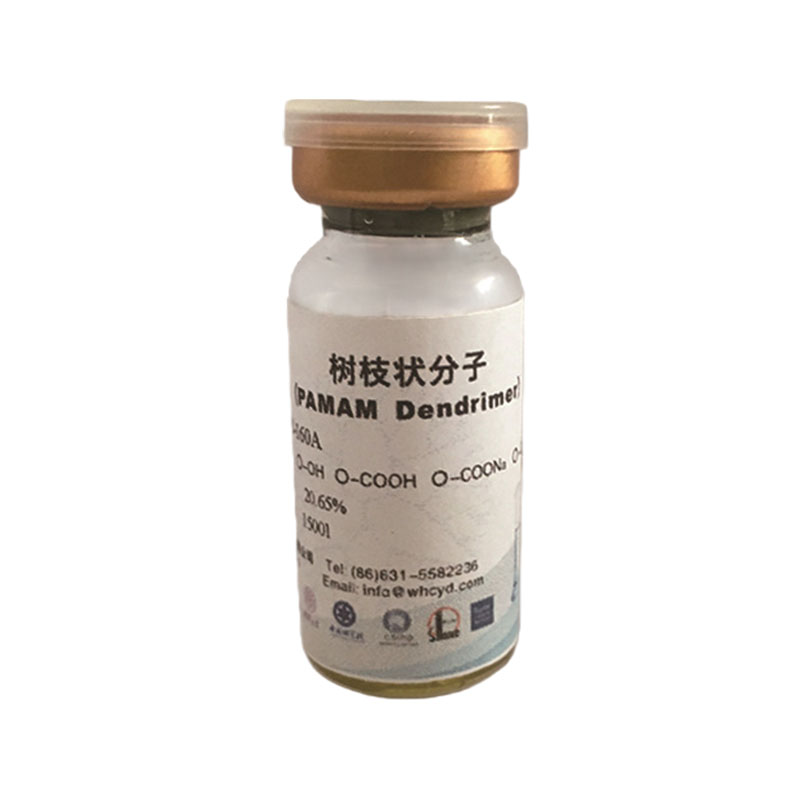
PAMAM dendrimers are a class of nanoscale polymers with a highly regular branched structure. Their unique "tree-like" topology gives them excellent loading capacity and structural stability in drug delivery, particularly valuable for anti-tumor drugs, gene therapy drugs, and small molecule drug delivery. The core of their performance advantage lies in the spatial characteristics and functional density advantages brought about by their highly branched structure.1. Highly Branched Structure Provides Abundant Drug Loading SpacePAAMAM dendrimers have a three-dimensional structure with layer-by-layer branching from the center outwards. Each generation significantly increases the number of terminal groups. This highly branched structure creates numerous nanoscale cavities and microenvironments, providing space for the physical embedding or adsorption of drug molecules. Compared to linear polymers, their structure is more compact and ordered, thus achieving higher drug loading efficiency.2. Enhanced Drug Binding Capacity Due to Terminal Functional GroupsPAMAM molecules are rich in active functional groups such as amine groups on their surface. These groups can bind to drug molecules through electrostatic interactions, hydrogen bonds, or covalent bonds. Since the number of terminal functional groups increases exponentially with molecular generation, their surface functionalization ability is significantly enhanced, thereby improving drug loading density and binding stability. This multi-point binding mechanism effectively reduces premature drug release during delivery.
3. Improved System Stability Due to Structural SymmetryPAMAM dendrimers possess a highly symmetrical and homogeneous molecular structure. This structural homogeneity enables them to exhibit good dispersibility and stability in solution. In drug delivery systems, this stable structure reduces aggregation or precipitation, thus maintaining the long-term stability of the drug carrier and facilitating continuous delivery during in vivo circulation.4. Optimized In vivo Distribution Behavior Due to Nanoscale SizePAMAMs are typically located in the nanoscale range, and their size can be precisely controlled through synthetic generations. This controllability allows for optimized distribution behavior in vivo while maintaining drug loading capacity. For example, lower generation structures are more conducive to tissue penetration, while higher generation structures have stronger drug loading capacity, thus achieving a balance between function and efficiency.5. Tunable Structure for Controlled ReleaseBy adjusting the generation and surface modification of PAMAM dendrimers, the drug release rate can be controlled. The highly branched structure not only encapsulates the drug but also forms a "diffusion barrier" through its outer functional groups, thereby slowing down the drug release rate. This structural regulation capability gives it a significant advantage in sustained-release and targeted delivery systems.6. Surface Modification Enhances Biocompatibility and TargetingThe surface of PAMAM dendrimers can be modified in various ways, such as by introducing PEG chains or targeting ligands. This modification not only reduces immunogenicity but also enhances its targeting ability in specific tissues or cells, thereby improving the precision and effectiveness of drug delivery.In summary, PAMAM dendrimers, through their highly branched structure, create abundant drug-loading space internally and provide high-density functional groups externally. Combined with their structural uniformity and tunable characteristics, they achieve a balance between high loading efficiency and high stability. This unique structural advantage makes it have significant application potential and development value in modern drug delivery systems.