How does aromatic polyurea coating simultaneously achieve abrasion resistance and adhesion to complex curved substrates?
Publish Time: 2026-02-17
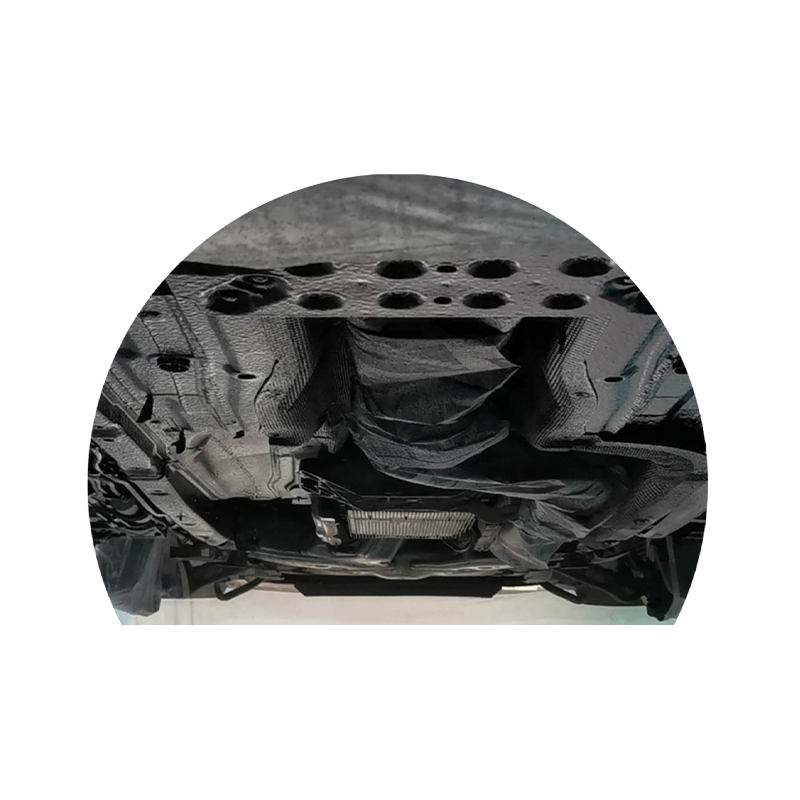
In harsh industrial environments, protective coatings often face a dilemma: the superior abrasion and impact resistance brought by high cross-linking density often comes at the cost of flexibility and adhesion; while flexible coatings that emphasize adhesion struggle to withstand high-intensity abrasion. Aromatic polyurea coating, however, successfully overcomes this contradiction. Thanks to its unique molecular structure, rapid reaction characteristics, and interfacial adaptability, it achieves long-lasting protection that combines rigidity and flexibility on complex geometric surfaces such as battery protection panels, automotive chassis, and heavy machinery.1. Highly Cross-linked Network and Microphase Separation Structure: The Molecular Basis of Abrasion ResistanceAromatic polyurea is generated by the reaction of isocyanate components with amino-terminated resins, forming a block copolymer composed of hard and soft segments. The urea bonds possess extremely strong hydrogen bonding forces, far exceeding those of urethane bonds in polyurethane, promoting high aggregation of hard segments and forming nanoscale crystalline microdomains. These microdomains act as "physical cross-linking points," endowing the coating with extremely high tensile strength, tear strength, and Taber abrasion resistance. Even under impact from gravel or friction from metal, the surface is not easily scratched or peeled.2. Rapid Gel and Low Shrinkage: Ensuring Full Coverage of Complex Curved SurfacesAromatic polyurea reacts extremely quickly—typically gelling within seconds and surface-drying within 30 seconds. This characteristic allows it to quickly "freeze" its form when sprayed onto complex structures such as vertical surfaces, grooves, welds, or bolt holes, avoiding sagging or accumulation and achieving uniform coverage. More importantly, its curing process produces almost no byproducts, with a volume shrinkage rate of less than 1%, significantly reducing internal stress. Low internal stress means that the coating and substrate will not detach due to shrinkage, maintaining a tight bond, especially in stress-concentrated areas such as edges and corners.3. Interfacial Chemical Anchoring and Mechanical Interlocking: Dual Adhesion MechanismAdhesion relies not only on physical adsorption but also on the synergistic effect of chemical and mechanical processes. First, the polar groups in polyurea can form hydrogen bonds or even covalent bonds with metal oxide layers, concrete hydroxyl groups, or functional groups on the plastic surface, achieving "chemical anchoring." Secondly, after sandblasting or priming the substrate before spraying, the roughened surface provides numerous microscopic anchoring points for the polyurea. The coating penetrates the pores and cures, forming a "mechanical interlock."4. Moderate Flexibility and Stress Buffering: Adapting to Dynamic LoadsDespite its high hardness, the polyurea coating can maintain an elongation at break of 10%–300% by controlling the ratio of soft to hard segments. This "high strength and high elasticity" characteristic allows it to absorb energy through micro-deformation when subjected to impact or thermal expansion and contraction of the substrate, preventing brittle cracking. For example, in automotive chassis applications, the coating bends repeatedly with vehicle vibration without peeling; at the bottom of battery packs, even if local dents occur due to gravel impact, the coating can still encapsulate cracks, preventing the intrusion of corrosive media.5. Optimized Application Process: Ensuring On-Site ConsistencyProfessional spraying equipment precisely controls the ratio of A/B components and the mixing temperature to ensure a complete reaction. Combined with specialized primers and surface treatment specifications, adhesion stability is maintained even in humid or low-temperature environments. Furthermore, a single application can achieve a film thickness of 500–1000 μm, eliminating the need for multiple application layers and reducing the risk of interlayer defects.
Aromatic polyurea coating achieves a balance between abrasion resistance and adhesion under extreme conditions through a multi-dimensional design combining rigid hard segments for abrasion resistance, flexible soft segments for cushioning, rapid curing and bonding, and interfacial chemical anchoring. It is not only a physical barrier but also an intelligently adaptable "active skin" that adapts to the substrate, providing a truly durable, reliable, and maintenance-free protective solution for modern industrial equipment.