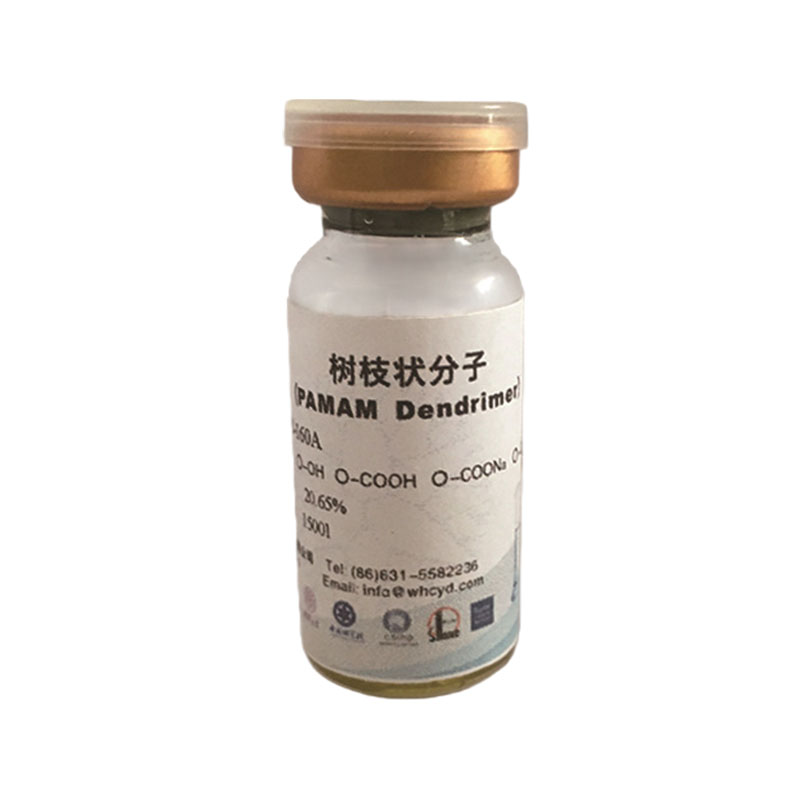
How can PAMAM Dendrimer meet the application requirements of targeted drug delivery and precision delivery through surface functionalization?
Publish Time: 2026-08-13
With the continuous development of precision medicine and nanomedicine delivery technologies, how to enable drugs to reach target sites more accurately while minimizing unnecessary impacts on normal tissues has become an important direction in drug carrier research. PAMAM Dendrimer, with its highly branched three-dimensional structure, abundant terminal functional groups, and tunable nanoscale size, provides a good structural basis for surface functionalization, thus showing great application potential in targeted drug delivery and precision delivery.1. Abundant Terminal Functional Groups Provide a Functionalization BasisPAMAM Dendrimer has a highly regular molecular structure, with a large number of terminal functional groups distributed on its surface that can be further modified. Researchers can chemically modify these surface groups according to different delivery requirements, introducing molecules with specific functions.In this way, different functional regions can be constructed on the same PAMAM molecule surface, enabling it to simultaneously perform functions such as drug loading, target recognition, and stable dispersion, thereby forming a more multifunctional nanodelivery platform.2. Targeted Molecules Enhance Recognition AbilityOne of the keys to precision delivery is enabling the drug carrier to have a certain target recognition ability. After functionalization, PAMAM surfaces can be linked to different targeting ligands according to research needs, allowing the carrier to be designed to target the biological characteristics of specific cells or tissues.Compared to ordinary carriers without functional modification, this surface functionalization strategy can further enhance the targeting of delivery systems. By rationally selecting and optimizing surface ligands, the interaction between the carrier and the target site can be improved, providing more flexible design space for subsequent drug delivery research.3. Three-dimensional cavity facilitates drug loadingIn addition to the surface structure, PAMAM has a special three-dimensional spatial structure that can provide loading space for some drug molecules and bioactive substances. Drugs can be encapsulated through the internal structure or further designed by combining surface functional groups.This combination of "internal loading + surface modification" allows PAMAM to be adjusted according to drug properties and delivery targets, thereby expanding its application possibilities in areas such as drug sustained release and targeted delivery.4. Adjustable structure meets different delivery needsPAMAM dendrimers have different generations and structural levels, with different structures corresponding to different sizes, numbers of surface functional groups, and internal spaces. By selecting appropriate structures and further adjusting surface functionalization methods, optimization can be achieved for different drugs and biomedical applications.For example, when designing delivery systems, the size of drug molecules, carrier stability, and characteristics of target tissues can be comprehensively considered. A rational combination of surface groups and functional molecules can be made to make the delivery system more suitable for specific application needs.5. Multifunctional Design Expands Precision Delivery ApplicationsThe value of PAMAM surface functionalization lies not only in targeted recognition but also in its ability to be combined with other functional designs, enabling further applications in drug sustained release, gene delivery, and in vitro diagnostics. By combining different functional modules, nanocarriers with multiple capabilities such as recognition, loading, and release can be constructed.Overall, PAMAM Dendrimer, with its abundant terminal functional groups, regular three-dimensional structure, and tunable nanoscale size, provides a large design space for surface functionalization. Introducing different functional molecules and targeting ligands can further enhance the flexibility of drug carrier design, providing an important material foundation for the development of targeted drug delivery and precision delivery technologies. Practical applications still require systematic evaluation and optimization in conjunction with specific drug systems and biosafety considerations.