In special vehicle applications, vehicles typically face complex and harsh environments for extended periods, such as mining transportation, military equipment, explosion-proof operations, and heavy engineering construction. In these environments, vehicle surfaces are frequently subjected to impacts from stones, metal friction, and high-frequency vibrations, and are also exposed to humidity, corrosion, and ultraviolet radiation for extended periods. Therefore, higher demands are placed on surface protection materials. As a high-performance elastomer protective material, aliphatic polyurea coating is widely used for surface protection of special vehicles due to its excellent impact resistance, wear resistance, and weather resistance.
1. Optimizing Material Formulation to Enhance Elastic Cushioning Capacity
In high-frequency impact environments, vehicle surfaces are continuously subjected to external impacts. If the coating lacks sufficient elasticity, cracking and peeling are likely to occur. Therefore, improving the material's inherent flexibility and resilience is crucial. Aliphatic polyurea materials typically combine highly reactive prepolymers with elastic segments, enabling the coating to rapidly absorb external energy upon impact and reduce impact damage through deformation buffering. Simultaneously, appropriately increasing the proportion of elastic soft segments can improve the material's ductility, maintaining structural stability under complex stress conditions. Furthermore, some high-performance polyurea systems incorporate nano-elastic fillers to further enhance impact absorption and reduce fatigue damage to vehicle surfaces caused by high-frequency impacts.
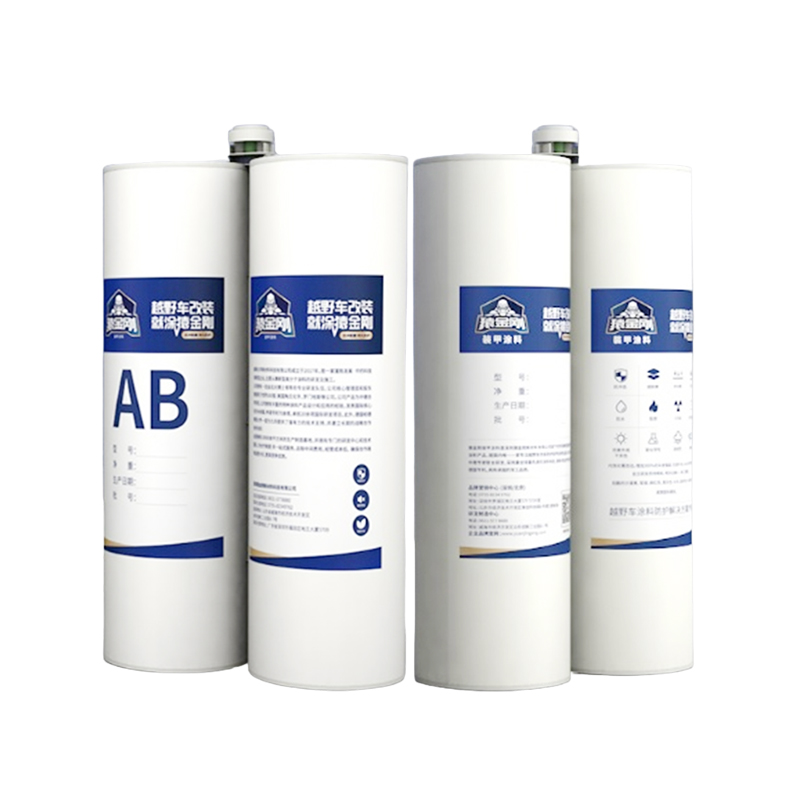
2. Enhanced Wear-Resistant Structure for Improved Long-Term Service Life
While high elasticity improves cushioning performance, insufficient material hardness can lead to surface wear under long-term friction. Therefore, in practical applications, a balance needs to be struck between flexibility and wear resistance. Currently, many aliphatic polyurea coatings employ composite reinforcement designs, introducing wear-resistant particles or high-strength fiber materials to improve surface scratch resistance. For example, on the surfaces of mining vehicles or armored equipment, coatings often need to withstand high-speed friction from sand and gravel; in such cases, wear-resistant fillers can effectively reduce the rate of surface wear. Simultaneously, optimizing the crosslinking density can enhance overall hardness while maintaining a certain level of elasticity, ensuring the coating maintains good surface integrity during long-term use.
3. Improve Adhesion Stability and Reduce Local Delamination
During the operation of special vehicles, continuous vibration and frequent impacts can easily lead to stress concentration between the coating and the substrate. If adhesion is insufficient, bulging, cracking, or even complete detachment may occur at the edges. Therefore, improving interfacial bonding is also crucial. To enhance the adhesion performance of polyurea coatings, the metal substrate is usually roughened by sandblasting before application to increase the surface bonding area. Simultaneously, using a high-performance primer can further improve interfacial bonding strength. In complex welding areas or corners, a layered spraying process is used to make the coating thickness more uniform, thereby reducing local stress concentration and improving overall protective stability.
4. Enhance Weather Resistance to Meet Complex Environmental Requirements
Special vehicles not only need to withstand high-frequency mechanical impacts but are also frequently exposed to high temperatures, humidity, salt spray, and strong ultraviolet radiation. If the material's weather resistance is insufficient, aging, chalking, or color changes are likely to occur. Compared to ordinary aromatic polyurea, aliphatic polyurea has superior resistance to yellowing and ultraviolet radiation, thus maintaining surface stability over a long period. Meanwhile, by adding antioxidants and corrosion-resistant additives, the material's protective capabilities in harsh environments can be further improved, preventing performance degradation due to external environmental influences and thus extending the overall service life of the vehicle.
Overall, the application of aliphatic polyurea coating in the high-frequency impact conditions of special vehicles requires a balance between elastic cushioning, wear resistance, and environmental stability. By optimizing the material formulation, enhancing the wear-resistant structure, improving adhesion stability, and strengthening weather resistance, the overall protective performance of the coating can be effectively improved, providing more durable and reliable surface protection for special vehicles.