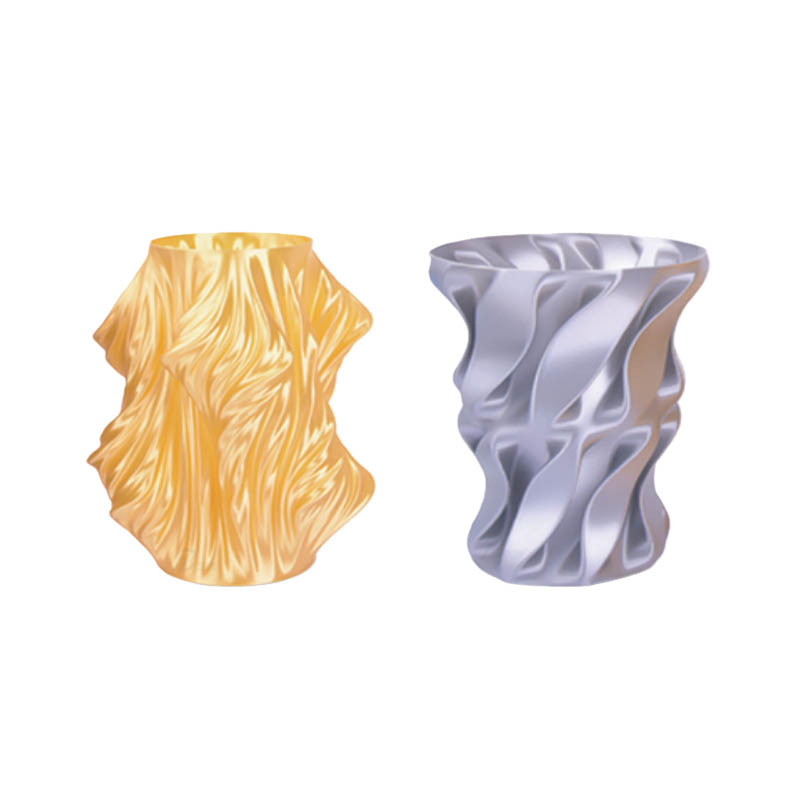
How to Maintain Silk-like Texture Continuity in PLA-SLIK Consumable Printing of Complex Curved Surfaces?
Publish Time: 2026-05-10
In 3D printing material systems, PLA-SLIK consumable is widely used in the production of art models, decorative parts, and high-quality prototypes due to its unique silk-like sheen and delicate surface effect.1. Stable Extrusion Control Ensures a Solid Foundation for Surface TextureThe core of the silk-like texture lies in the stability of the material extrusion process. PLA-SLIK requires maintaining a uniform and continuous extrusion flow during printing to avoid surface texture breakage caused by material fluctuations. In complex curved surface structures, the nozzle movement direction constantly changes. If the extrusion is unstable, micro-aggregates or voids can easily form, thus disrupting the smooth and continuous visual effect. Therefore, precise control of extrusion speed and retraction parameters is fundamental to maintaining the continuity of the silk-like texture.2. Layer Height and Path Planning Optimize Surface ContinuityIn complex curved surface models, the curvature varies significantly in different areas. If the layer height is not set properly, it will lead to obvious layer textures, thus affecting the continuity of the silk-like texture. By employing a lower and more uniform layer height setting, the stair-step effect between layers can be reduced. Simultaneously, optimizing the slicing path, ensuring the nozzle movement follows the flow lines of the curved surface as much as possible, reduces gloss interruptions caused by transitions, resulting in a more continuous and natural surface reflection.3. Temperature Control Affects Gloss UniformityThe silky effect of PLA-SLIK consumables is closely related to the material's melting state. In printing complex curved surfaces, inconsistent cooling rates in different areas can easily lead to gloss differences. Appropriately increasing the nozzle temperature can enhance material flowability, making it more uniform during spreading, thus forming a continuous, smooth surface. At the same time, by properly controlling the cooling fan intensity, gloss breakage caused by localized excessively rapid solidification can be avoided.4. Printing Speed and Acceleration Control Reduces Texture BreakageIn areas with significant surface changes, excessively rapid changes in printing speed or acceleration can lead to uneven material deposition, affecting the continuity of the silky texture. By smoothly adjusting the motion acceleration, maintaining a stable nozzle operation in curved transition areas, micro-texture disturbances caused by inertial changes can be reduced, thereby improving the overall surface consistency and smoothness.5. Synergistic Effect of Material Formulation and Optical PropertiesPLA-SLIK incorporates additives that enhance gloss and toughness into the PLA substrate. These microstructures create a silk-like visual effect during light reflection. In complex curved surface models, the superposition of light reflections from different angles further amplifies the visual texture. By optimizing the dispersion uniformity in the material formulation, the optical consistency between different curved surface areas can be further improved, resulting in a more natural and continuous silk texture.In summary, PLA-SLIK consumable effectively maintains the continuity of the silk texture in the printing of complex curved surface models through multiple technical means, including extrusion stability control, path and layer height optimization, temperature regulation, motion parameter optimization, and the synergistic effect of material optical properties. This comprehensive optimization enables it to exhibit excellent visual performance in high-end 3D printing applications.