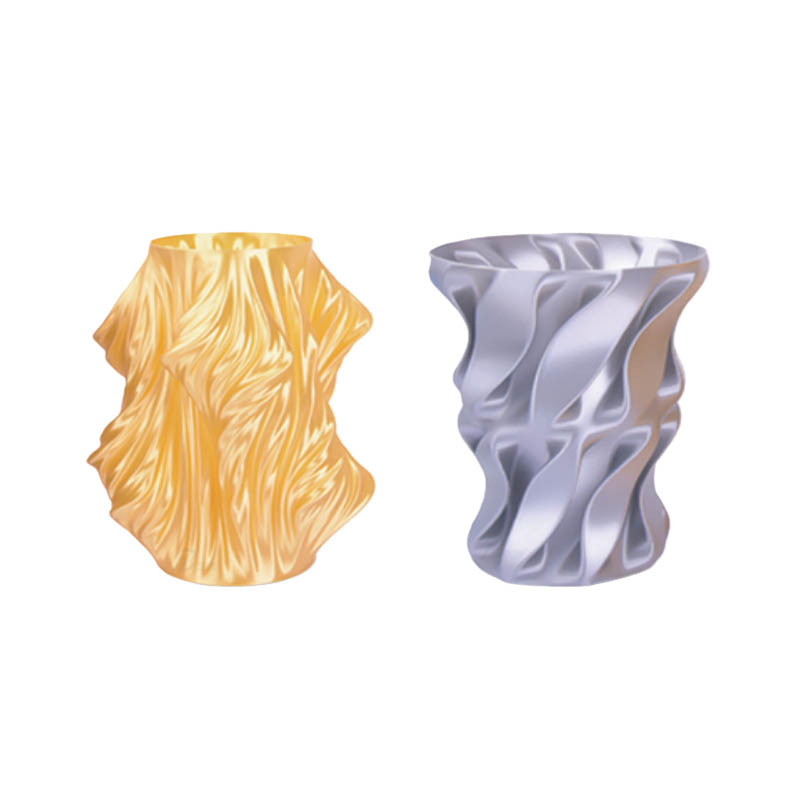
PLA-SLIK consumable, with its high-gloss surface, delicate texture, and excellent molding performance, is widely used in decorative models, display parts, and high-end visual model printing. In high-precision miniature model printing, this material not only needs to present richly detailed structural features but also ensure overall molding stability.
1. Optimize Printing Parameters to Enhance Detail Reproduction Capability
In miniature model printing, printing parameters directly impact detail reproduction. Due to the high fluidity of PLA-SLIK consumable, excessively high nozzle temperatures or printing speeds can lead to excessive material diffusion, blurring fine structures. Therefore, it's necessary to reduce melt flow by lowering the nozzle temperature range and appropriately reduce the printing speed to allow for rapid material settling after deposition. Furthermore, reducing the layer height significantly improves detail reproduction along the Z-axis, making micro-textures clearer and enhancing overall model accuracy.
2. Enhance Cooling Control to Improve Structural Stability
The curing speed of PLA-SLIK consumable during the cooling stage has a significant impact on structural stability. Insufficient cooling can easily lead to collapse or deformation during stacking, especially noticeable in small, cantilevered structures. Therefore, it is necessary to appropriately increase the air cooling intensity during printing to ensure rapid curing of the extruded material. Simultaneously, optimizing the airflow direction to ensure uniform cooling airflow across the model surface can prevent warping or interlayer misalignment caused by inconsistent local shrinkage, thereby improving overall structural stability.
3. Reasonably Control the Flow Coefficient to Prevent Detail Overflow
In micro-model printing, flow control is a crucial factor affecting detail clarity. Due to the plasticizing properties of PLA-SLIK consumable, excessively high flow rates can cause material accumulation at edges, affecting the boundary accuracy of micro-structures. Therefore, it is necessary to appropriately reduce the flow coefficient to minimize excessive material extrusion, resulting in finer and clearer lines. Furthermore, when printing sharp edges or fine textures, optimizing the retraction settings can reduce stringing, further enhancing the model's detail representation.
4. Optimize Model Structure Design to Improve Printing Feasibility
Besides printing parameters, the model's structural design also affects the final print quality. During the micro-model design phase, excessively extreme suspended structures or overly thin-walled designs should be avoided, as these structures are prone to instability or deformation during printing. Appropriately increasing support structures or optimizing structural transition areas can improve the overall printing success rate. Simultaneously, appropriately increasing structural thickness in key detail areas helps improve printing tolerance, allowing the model to maintain visual detail while possessing better structural strength.
5. Control Environmental and Equipment Stability to Improve Consistency
The stability of the printing environment is equally important for high-precision models. Significant temperature fluctuations or airflow interference can cause uneven shrinkage of the PLA-SLIK consumable during cooling, affecting detail consistency. Therefore, the printing environment temperature should be kept as stable as possible, and external airflow interference should be avoided. At the same time, ensure the extruder and nozzle are in good condition, avoiding uneven extrusion due to wear or blockage, thus ensuring the stability of the printing process from the source.
In summary, by optimizing printing parameters, strengthening cooling control, rationally adjusting the flow coefficient, optimizing model structure design, and improving environmental stability, the detail reproduction and structural stability of PLA-SLIK consumable in high-precision micro-model printing can be effectively improved, enabling it to achieve more stable and high-quality molding results while maintaining the silk texture and fine performance.